
Why Does My Flash Photography Look So “Flashy”? (And How to Fix It)
If you’ve ever tried using flash and thought:
“This looks harsh.”
“This looks fake.”
“This does not look like natural light.”
You’re not alone. A lot of family photographers try flash once or twice,hate how it looks, and decide “I’m just not a flash person.”
But here’s the truth:
Flash doesn’t have to look flashy.
The flash isn’t the problem, the technique is.
And once you understand that, everything changes.
Let’s break it down simply.
First: What Does “Flashy” Even Mean?

Hard light tends to look “flashy”
When photographers say their flash looks “flashy,” they usually mean:
Harsh shadows
Bright hotspots on skin
Flat light with no dimension
Catchlights in the wrong place
In other words, it doesn’t look believable.
It doesn’t look like window light.
It looks like… flash. And most of don’t want that. So lets fix it!
The Real Reason Your Flash Looks “Flashy”
There are three common reasons flash looks “flashy”:
The light source is too small
The light is coming from the wrong direction
The light is too close to the lens axis (on-camera)
That’s it.
Just those three things.
Let’s look at each one.
Problem #1: Your Light Source Is Too Small
Small light sources create hard light.
Hard light creates:
Sharp shadow edges
Strong contrast
Bright hotspots on skin
And that’s what feels “flashy.”
If you’re using:
Bare flash
A tiny modifier
Direct on-camera flash
You’re working with a very small light source. And your images will look harsh.
Compare that to a large window.
A large window produces soft transitions between highlights and shadows.
So if you want flash to look like window light, your flash needs to behave like a window.
To achieve that you can:

Soft light created with a large umbrella placed on a flash.
Use a large umbrella (45–60 inches minimum)
Bounce your flash off a white wall
Bounce your flash off a ceiling
Bounce your flash off a window
When you bounce light, that surface becomes your light source.
Large wall = large soft light.
And softness is what makes flash feel natural.
Problem #2: Your Light Is Coming From the Wrong Direction

Loop light is a pleasing lighting pattern that is very flattering and looks natural.
Light that looks natural usually comes from:
The side
Slightly above eye level
Light that looks artificial usually comes from:
Directly in front of your subject
Below their face
Straight from the camera
When flash is mounted on your camera and pointed forward, the light is almost perfectly aligned with your lens.
That creates flat light.
Flat light removes dimension.
And dimension is what makes portraits feel real.
If you want your flash to look natural:
Move the flash off-camera.
Place it about 45 degrees from your subject.
Raise it slightly above eye level.
Angle it downward.
Then check the catchlights.
Catchlights should be in the top half of the eye.
If they’re in the bottom half?
Your light is too low (this creates “ghoul lighting,” which feels unsettling and looks unflattering).
Direction matters. So pay attention to this step!
Problem #3: Your Flash Is Too Close to Your Lens (Lens-Axis Lighting)
This is the one that gets overlooked.
When your flash is sitting directly on top of your camera and pointing forward, the light is traveling from almost the exact same direction as your lens.
That means:
Shadows fall directly behind your subject
Texture disappears
Faces look flat
The image feels two-dimensional
This is called lens-axis lighting — and it’s one of the biggest reasons flash looks “flashy.”
Natural light almost never comes from the same direction as our eyes.
Windows are off to the side.
The sun is overhead.
Indoor lamps are positioned away from our line of sight.
But on-camera flash puts the light exactly where your lens is.
That’s why it feels unnatural.
The solution?
Even a small shift makes a difference.
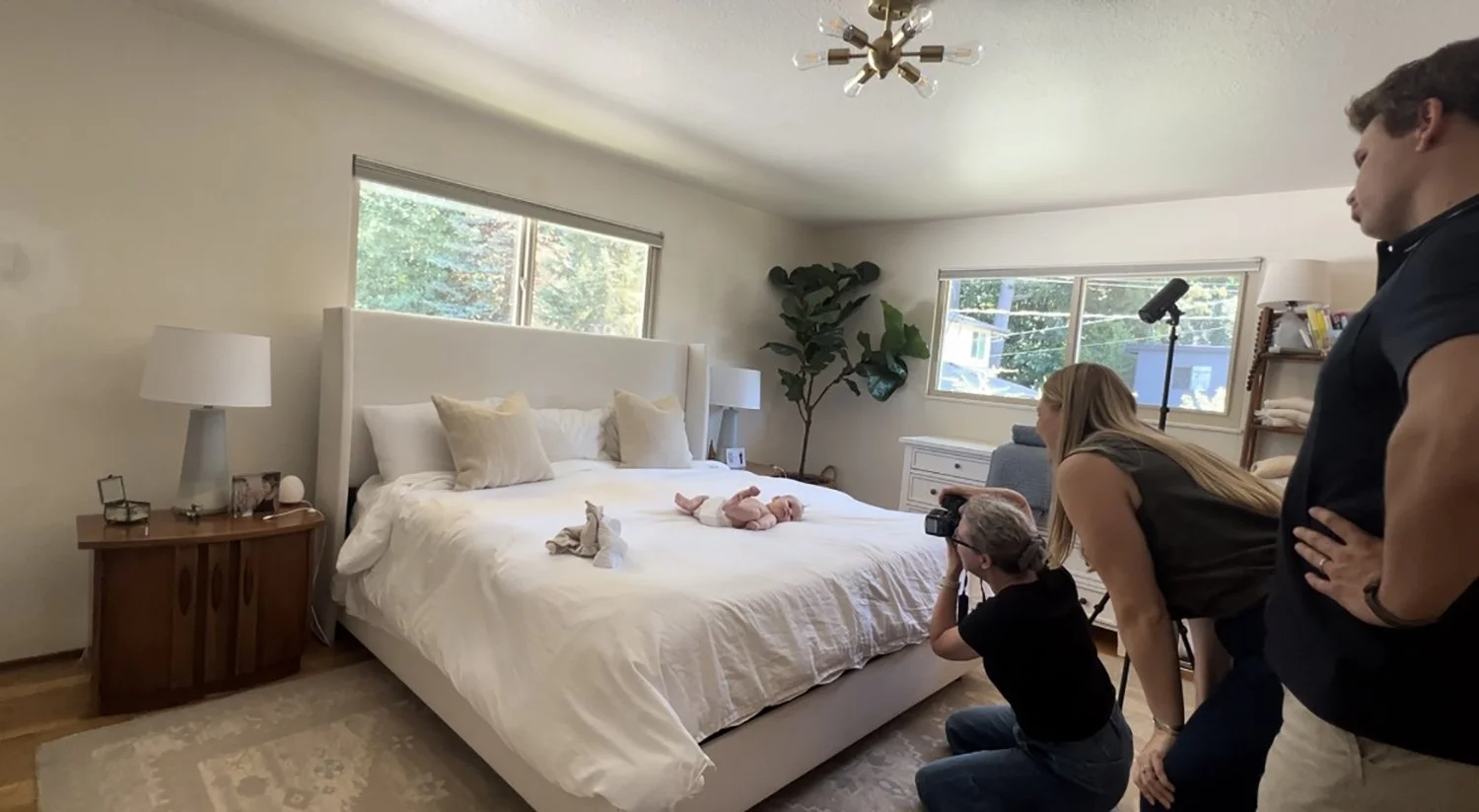
Off camera flash creates natural-looking light!
Take the flash off camera.
Swivel the flash head and bounce it off of a wall or window.
Or move it slightly to one side.
The moment you separate the light from the lens, dimension returns.
And your images immediately feel more natural.
Want to Master Natural-Looking Flash in Client Homes?
Reading about light is one thing.
Walking into a dark nursery and knowing exactly what to do is another.
In Lighting on Location: Off-Camera Flash for In-Home Photographers, I teach you my complete system for creating natural-looking light in real homes.
You’ll learn:
My step-by-step room assessment process
How to choose between natural light and flash
Where to start when you feel stuck
What equipment you need (and what you don’t)
What using flash on location looks like in action! I have lots of behind the scenes videos to help you get comfortable bringing flash into your clients’ homes.
If you want to stop guessing and start walking into sessions with a plan, this class is for you.