
How to Light In-Home Newborn Photos (Using Just One Light)
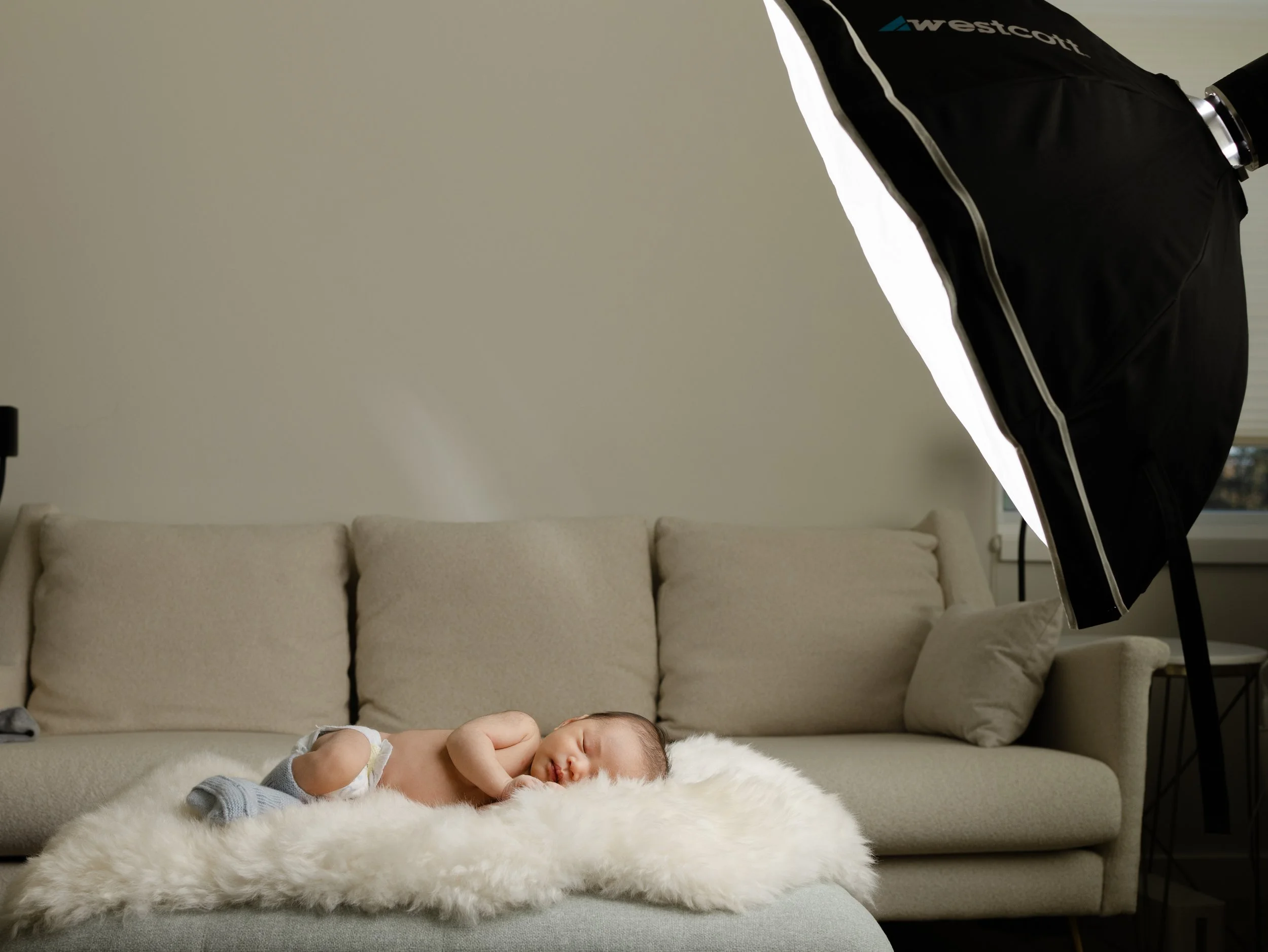
Lighting in-home newborn sessions can feel intimidating.
You walk into a client’s home and immediately start assessing:
Is there enough window light?
How can I photograph the entire family with just one window?
What if the family wants photos in a windowless room?
I can’t fit lighting equipment into these tight spaces!
If you’ve ever felt your stomach drop the moment you step into a nursery, you’re not alone.
But here’s the truth:
Lighting in-home newborn photography is not about luck. It’s about having a plan.
And you don’t need five lights, complicated setups, or perfect window light to do it.
You need one light and a repeatable system.
Why In-Home Newborn Lighting Feels So Hard
In a studio, you control everything.
The background
The ambient light
The space
The setup
The direction of light
In a client’s home? Every session is different.
You’re navigating:
Small nurseries
Tight bedrooms
Overhead lights with mixed color temperatures
Dark hallways
Furniture
Small windows
Or no windows at all!
And when you don’t have a system, every room feels like a new puzzle to solve.
That’s where the anxiety comes from.
Not from lighting itself, but from unpredictability.
The Biggest Problems with In-Home Newborn Photography Lighting

Let’s name the most common challenges:
1. Not Enough Light
Many nurseries are surprisingly dark.
Small windows.
Heavy curtains.
Neighboring houses blocking light.
You can raise your ISO, but that only solves exposure, not quality. And often results in images with unflattering digital noise.
2. Unflattering Shadow Patterns
Light coming from below the baby’s face (ghoul lighting). Deep shadows in eye sockets. Uneven light across the bed.
Sound familar?
You may have enough light for good exposure, but not the right light for flattering photos!
3. Green or Blue Color Casts
Trees outside windows reflect green light into the room.
Wall colors bounce pigment back onto skin.
Mixed overhead lighting creates strange tones.
Editing can help, but it’s far better to fix it in real time.
4. Tiny Spaces
Maybe you’ve thought about bringing in lighting, but you don’t have room for:
Giant modifiers
Multiple light stands
Big studio setups
And the baby isn’t going to wait while you figure it out where to set every thing up!
The Solution: One Light + A Repeatable Plan
Here’s what I want you to understand:
The rules of light are the same everywhere.
Whether you’re in your studio or in a nursery, light still behaves the same way.
So instead of reinventing the wheel at every session, I use a simple, repeatable system.
And it starts in the same place every time.
Step 1: Assess the Room Quickly
When I walk into a client’s home, I ask four questions:
Who am I photographing? (newborn alone? parents too?)
Where can I position them comfortably?
What is the existing light doing?
How can I improve it?
I always look at:
Window size
Direction of light
Shadow pattern
Color cast
Available bounce surfaces (walls, ceiling, windows)
Then I decide: natural light or artificial light?
If the window light is beautiful and flattering, I’ll use it.
If it’s not — I bring in one light.
Step 2: Start by the Windows
This is my baseline.
Even when I’m using flash or a strobe, I begin by setting up on the window side of the room.
Why?
Because that’s where natural light would normally come from.
Humans are used to seeing light from above and from windows. When we mimic that direction, the result feels natural.
Starting by the windows helps:
Maintain believable light direction
Avoid unnatural uplighting
Create flattering shadow patterns
Keep the environment looking realistic
It gives you a place to begin — and that alone builds confidence.
Step 3: Bounce the Light for a Natural Look
When working in small spaces, bouncing light is incredibly effective.
Instead of pointing the flash directly at the baby, I bounce it:
Off the ceiling
Off a neutral wall
Off the window
Off the top corner of the room
When you bounce light, the surface becomes your light source.
And larger surfaces create softer light.
Soft light is ideal for newborn photography.
This technique:
Eliminates harsh shadows
Neutralizes color cast
Fills the room evenly
Maintains a natural look
And best of all — it requires minimal equipment.
Why One Light Is Enough for In-Home Newborn Sessions
You do not need a complicated lighting setup.
In fact, more gear often creates more stress.
With one off-camera flash or strobe, you can:
Control direction
Control softness
Control color temperature
Control shadow depth
Work in any room, day or night
The key isn’t quantity.
It’s intentional placement.
How This Builds Confidence
Confidence doesn’t come from memorizing diagrams.
It comes from having a starting point.
When you know:
Where to begin (window side)
What to look for (shadow patterns, color cast)
How to fix common problems (bounce + reposition)
That one light is enough
You stop feeling overwhelmed.
And when you feel calm, your clients feel calm.
That changes the entire session.
What About Natural Light?
Natural light can be beautiful.
But relying on it completely means:
Weather controls your schedule
Time of day limits your options
Window placement dictates your posing
Editing becomes heavier
Adding artificial light doesn’t mean abandoning natural light.
It means enhancing it.
It means having control.
Frequently Asked Questions About Lighting In-Home Newborn Sessions
Do I need a large modifier in a nursery?
Not necessarily. In tight spaces, bouncing flash off ceilings or walls often works better than large modifiers.
Will flash disturb the baby?
Modern flash is quick and subtle. Used properly, it does not disturb newborns.
What if the walls are colored?
Avoid bouncing off saturated surfaces. Use neutral walls, ceilings, or windows to maintain clean skin tones.
Is off-camera flash difficult to learn?
It can feel intimidating at first. But when you simplify it to one light and a repeatable process, it becomes manageable — and eventually empowering.
The Truth About Lighting in Client Homes
Using artificial light in a client’s home can feel awkward at first.
You may move your light more than once.
You may experiment.
You may adjust.
That’s normal.
Every room is different.
But when you stop guessing and start working from a plan, everything shifts.
Lighting in-home newborn sessions stops feeling chaotic.
It starts feeling controlled.
And that confidence shows in your work.
Final Thoughts
If you want to light in-home newborn photos with confidence, focus on this:
Learn how light behaves.
Start by the windows.
Use one light.
Bounce intentionally.
Adjust without panic.
You don’t need perfect homes.
You don’t need perfect weather.
You don’t need a studio.
You need a plan.
And once you have that, slow season becomes optional.